







12 November, 2026


Choosing the right porcelain slab thickness can affect how a surface looks, performs, and is installed. Common options include 9mm, 12mm, 15mm, and 20mm. Yet the thickest slab is not always the best choice.
Your decision should reflect the application, slab dimensions, substrate, cabinet support, cutouts, overhangs, and desired edge style. Access, transportation, and installation conditions also matter. Keep in mind that nominal and finished thickness may vary by product line. Always confirm exact details on the technical data sheet.
This porcelain slab thickness compares the main options for countertops, floors, walls, furniture, bathrooms, and outdoor projects.
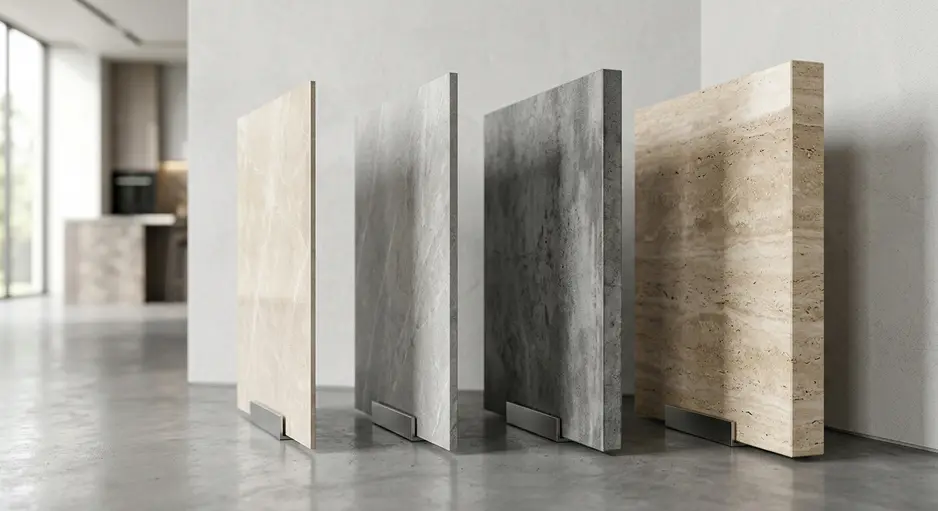
As a general guide, 9mm works well for lightweight vertical surfaces and supported installations. A 12mm slab is widely considered for countertops and vanities. The 15mm option offers added rigidity without the full weight of 20mm, while 20mm is often selected for substantial worktops and outdoor kitchens.
These porcelain slab weight per square foot figures assume a density near 2,400 kg/m³. Actual weight varies by composition, dimensions, and manufacturer.
No. Thickness may improve stiffness, but it does not tell the whole story. Bending strength, impact resistance, cutout placement, substrate quality, fabrication, and slab installation methods all affect performance. Product-specific test results should guide the final selection.
A thicker slab is generally more rigid and less likely to flex under the same conditions. However, structural load capacity should not be confused with surface durability. Porcelain can offer strong scratch resistance and stain resistance while still being vulnerable to poor support or hard impacts along an exposed edge.
Published bending strength and thermal shock resistance data should come from the exact product being ordered. Relevant testing may follow the ISO 10545 series or standards such as ANSI A137.3.
Sink openings, cooktop cutouts, faucet holes, inside corners, and narrow strips are common risk areas. Even a thick slab can crack when a cutout is poorly shaped or the surface is twisted during handling. Radiused inside corners and suitable porcelain slab fabrication techniques help reduce stress concentration.
Common edge profile options include straight, eased, mitered, laminated, and built-up edges. A skilled fabricator can make a 12mm surface appear 20mm or 40mm thick with a mitered edge. This creates a substantial look without using a thicker slab throughout, although it adds labor and requires accurate bonding.
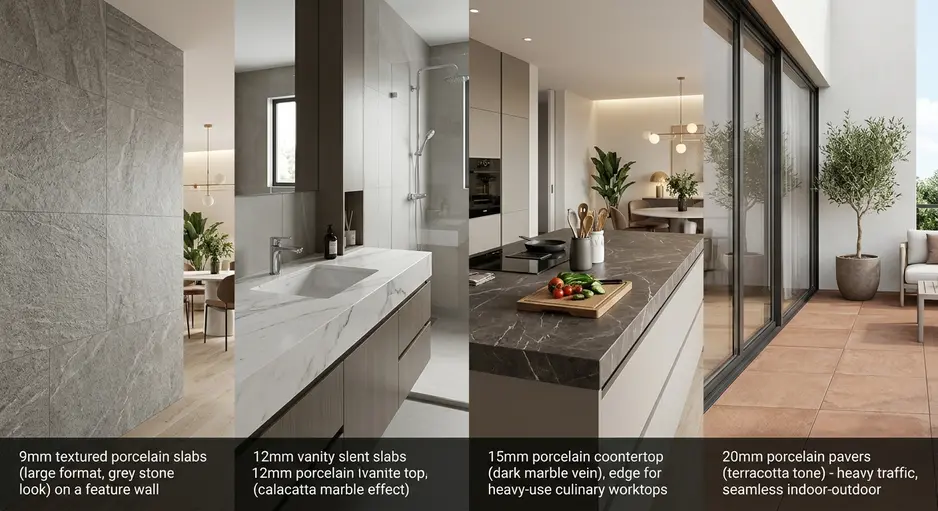
A 9mm porcelain slab can suit shower walls, wall cladding, furniture panels, cabinet facings, and approved fireplace surrounds. Its lower weight makes it useful where reduced dead load and broad visual coverage are priorities.
It may also work in supported flooring or worktop systems when approved by the product manufacturer. Its limitations include greater handling sensitivity and less margin around openings or unsupported edges. Flat, stable substrate requirements are especially important.
In many approved systems, yes. A 12mm porcelain slab offers a practical balance of weight, rigidity, appearance, and fabrication flexibility. Suitability still depends on cabinets, perimeter support, sink type, appliance cutouts, seams, and overhang length.
For the 9mm vs 12mm porcelain slab decision, 9mm when low weight and vertical coverage are key. Consider 12mm for supported countertops, vanities, tables, and busy interiors. Ask the fabricator to approve any unusual shape before ordering.
A 15mm porcelain slab sits between lightweight panels and worktops. It provides more rigidity than 9mm or 12mm while remaining lighter than 20mm. It can work well for premium counters, tables, and furniture, but availability may vary by brand and market.
A 20mm porcelain slab may suit kitchen islands, commercial worktops, hospitality counters, and outdoor cooking areas. It also creates a substantial edge without a built-up profile. The trade-offs are greater weight, higher cabinet loads, harder transportation, and more demanding handling equipment.
It may provide more rigidity, but thickness alone does not establish a safe cantilever. Countertop overhang support depends on depth, width, cutouts, seams, expected live loads, and the support frame. Brackets or concealed may be needed.
The best porcelain slab thickness for kitchen countertops is often selected from 12mm, 15mm, or 20mm. A supported 12mm surface can offer a slim, modern look. A 20mm slab provides greater rigidity and visual weight. Sink type, island size, edge design, cutouts, and cabinet strength should guide the choice.
Porcelain slab thickness for bathroom vanities may range from 9mm to 12mm in smaller, well-supported designs. Vessel sinks, undermount basins, and faucet holes can change the support plan. Wall-hung vanities also need verified framing and suitable load capacity.
Porcelain slab thickness for flooring must follow an approved installation system. Substrate flatness, deflection, mortar coverage, joints, and traffic are as important as thickness. Commercial floors may also need rolling-load and point-load checks.
For walls, thinner panels reduce dead load and are easier to position across large areas. Wet zones need approved waterproofing and adhesives. Some projects may also require mechanical fastening.
Porcelain slab thickness for outdoor use cannot be chosen by thickness alone. Confirm freeze-thaw suitability, water absorption, slip resistance, UV stability, drainage, movement joints, and thermal shock resistance. A 20mm slab may add rigidity, but it still needs an exterior-rated installation system.
Porcelain slab thickness for commercial projects depends on traffic, cleaning, accessibility, fire requirements, and expected loads. Counters may benefit from 15mm or 20mm material. For furniture applications, thinner slabs can reduce weight on tables, cabinet doors, elevator interiors, and decorative panels.
Walls and floors require flat, stable, compatible substrates. Countertops need level cabinet runs and support around sinks, appliances, seams, and narrow sections. Extra thickness should never be used to hide an unsuitable base.
Installation should follow the product manual and relevant guidance, such as ANSI A108.19 and suitable TCNA methods. Adhesive type, coverage, movement joints, and curing conditions must match the system.
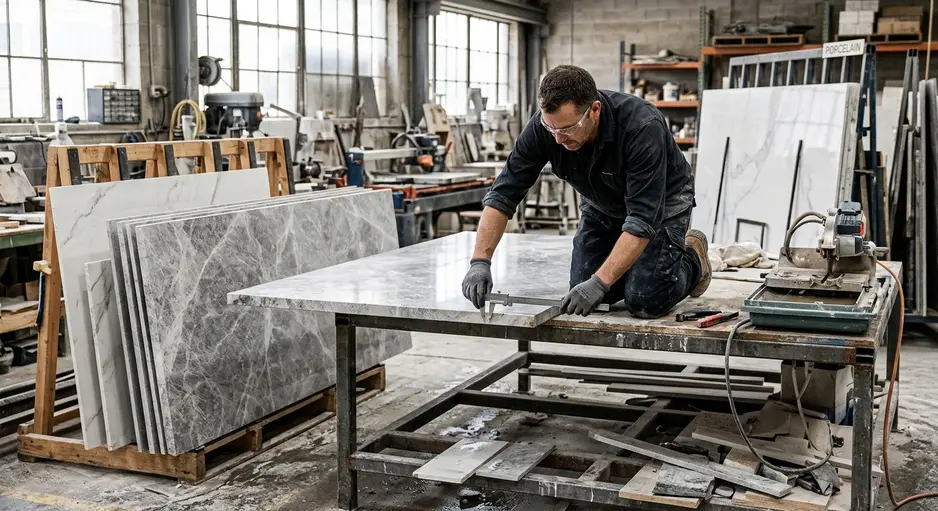
Large porcelain surfaces require suitable wet-cutting tools, bridge saws, drill bits, templates, and handling systems. Waterjet cutting may be used for complex openings. Internal corners should be radiused where required, and trial cuts can help confirm tool settings.
Cutting porcelain may release respirable crystalline silica. Fabricators must use wet methods, extraction, respiratory protection, and other OSHA-compliant controls. This is specialist work and should not be treated as a basic on-site cutting task.
Trained crews use A-frames, lifters, carrying frames, and suitable porcelain slab handling equipment. Slabs should remain supported in the approved orientation. Delivery access must be checked in advance to avoid twisting, sudden point loads, or unsafe field handling.
Request the technical data sheet, installation manual, warranty, test results, batch details, finish samples, and fabricator approval. Compare the complete installed system rather than choosing by price or appearance alone.
You can contact IBIS Smart Marble to ask about current sizes, finishes, thickness options, packing details, samples, and application-specific technical information. Confirm availability before completing the project specification.
Buy Best Porcelain Slab Marble
The right thickness depends on more than appearance. A 9mm panel can be ideal for walls and furniture, while 12mm suits many supported counters and vanities. A 15mm slab adds rigidity, and 20mm can serve substantial worktops and outdoor designs.
For the safest result, review the slab, substrate, support, fabrication, transport, and installation as one system. Product-specific technical data and experienced installation matter more than selecting the thickest option available.
There is no single standard thickness for every product or use. Large-format surfaces may be offered in options such as 9mm, 12mm, 15mm, and 20mm. Exact sizes and tolerances depend on the manufacturer.
It may be suitable in a fully supported and approved system. However, its use around sinks, cooktops, seams, and overhangs must be confirmed by the manufacturer and fabricator.
A 12mm slab is lighter and works well for many supported designs. A 20mm slab offers greater rigidity and a thicker appearance. Cabinet support, openings, edge style, and handling conditions determine is better.
Greater thickness can improve stiffness, but it does not prevent every crack. Poor support, substrate movement, transport damage, sharp cutout corners, or incorrect installation can cause failure at any thickness.
Yes. A qualified fabricator can create a mitered or built-up edge that looks much thicker than the main slab. The design must follow approved fabrication and bonding methods.

Whatsapp Chatx
Hi! Click one of our representatives below to chat on WhatsApp or send us email to info@ibissmartmarble.com

|
Contact Us +91 95812 95812 |